
Intelligent Continuous Tire Pyrolysis Plant | Tire-to-Fuel Production Line (TPO, rCB, Steel)
The accelerating growth in global vehicle ownership is driving a corresponding surge in end-of-life tires (ELTs) and scrap tire generation. As volumes rise, the cost and risk profile of legacy disposal routes becomes more visible, while demand increases for scalable, regulated recovery capacity. For investors, this is a structural market opportunity tied to tightening waste policy, extended producer responsibility (EPR), and industrial decarbonization priorities.
Traditional scrap tire disposal pathways, including landfilling and uncontrolled burning or low-standard incineration, are increasingly constrained by regulation and community acceptance, and they forfeit the embedded value of tire-derived hydrocarbons, carbon, and steel. The market is shifting toward industrial solutions that can demonstrate continuous operation, emissions compliance, and credible offtake readiness, the core prerequisites for bankability.
Klean Industries is an international specialist in continuous tire pyrolysis, with engineering heritage developed through industrial work in Europe and Asia. Klean has developed an industrial continuous scrap tire pyrolysis production line designed to operate with stable control of key process variables. In practical terms, the technology is built to convert scrap tires into marketable commodity streams, including tire pyrolysis oil (TPO), recovered carbon black (rCB), and recycled steel wire, along with other recoverable fractions. This model shifts ELTs from a long-term environmental liability into a feedstock for circular, auditable resource recovery.
Klean’s tire pyrolysis solution is positioned as a closed-loop system aligned with circular economy principles. Under oxygen-free or oxygen-limited conditions and at controlled temperatures, the tire’s polymer matrix decomposes into smaller fractions that can be recovered as gas, liquid, and solid products. The liquid stream, TPO, can be directed into appropriate downstream energy or refining pathways subject to specification and regulatory requirements. The solid stream can be upgraded into rCB for selected rubber and plastics applications depending on finishing and quality assurance. The recovered steel can be returned to established metals markets. For investors, the commercial relevance is straightforward: a properly engineered plant can create multiple revenue streams while materially reducing disposal risk and improving regulatory alignment.
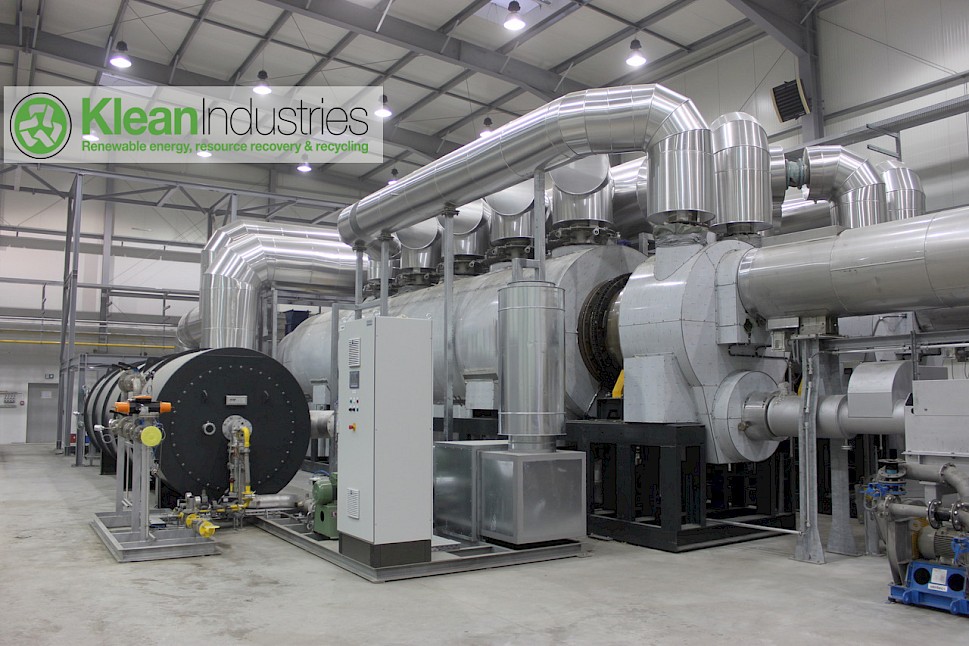
Lessoned Learned from German Project
European proof-of-concept history makes one point clear for investors: tire pyrolysis is not validated by short trial runs. It is validated by long-duration, continuous operation, predictable maintenance performance, consistent product quality, and sustained compliance with stringent emissions requirements. The TPL facility in Hoyerswerda, Germany was an early attempt to industrialize tire pyrolysis at scale. Several key issues were encountered at the plant as it suffered from significant processing and control challenges and that product quality and market acceptance were major constraints. The project ultimately became an expensive KleanTeam case study in why operability and quality consistency determine whether a plant can secure long-term offtake and financing confidence.
For investors, the takeaway is not simply that early projects struggled. It is that bankability depends on design choices that prioritize availability, runtime stability, emissions performance, and product specification control. Where systems are not purpose-built for tire pyrolysis, the consequences typically surface as downtime, high maintenance burden, variable product quality, and permitting or compliance risk. These issues directly undermine unit economics and offtake reliability.
The KleanTeam has been dedicated to the research, development, and industrial application of pyrolysis technology for decades, with a specific emphasis on continuous processing at commercial scale. Klean’s intelligent continuous pyrolysis production line is built around controlling the variables that most directly drive operating performance and financial outcomes, including heating temperature, heat transfer performance, residence time distribution, working pressure stability, and sealing integrity, alongside extensive operating parameters embedded into the plant’s control philosophy. The objective is to address common industry failure modes such as coking, vapor instability, dynamic sealing challenges at feed and discharge, and product polymerization risk, enabling stable and continuous operation over extended campaigns.
From an investor perspective, this engineering focus is not academic. It is how projects shift from “technology risk” to “infrastructure-grade performance.” Continuous operation reduces cash flow volatility, supports contracted offtake, improves compliance confidence, and strengthens financing outcomes. In parallel, consistent outputs increase the probability of qualifying products into higher-value markets and sustaining those relationships over the long term.
Klean Industries has also completed a Master Licensing Agreement with KBR, under which KBR holds global licensing rights for Klean’s continuous tire pyrolysis technology and supports worldwide market deployment through structured licensing and delivery. This framework is designed to scale project execution capacity while maintaining consistent technology standards, safety practices, and performance expectations. For investors, it provides a clearer pathway to replicable project delivery and governance across multiple jurisdictions, including those with stringent environmental requirements.
Schedule an investor screening call to review technology risk, compliance approach, commodity pathways for TPO and rCB, and the commercial structure enabled through KBR licensing.
Learn more:
- Tire Pyrolysis Project
- Pyrolysis Oil Fuel Credits
- Tyre Pyrolysis Guide
- Plastic Pyrolysis Solutions
- Tire Pyrolysis Plant Setup
Revolutionizing Tire Recycling Together — Klean Industries & KBR Lead the Way
Klean Industries’ proven pyrolysis technologies and KBR’s global engineering capabilities form a powerhouse partnership to commercialize sustainable commodity recovery from end-of-life tires at scale.
Looking to deploy scalable, integrated ELT recycling plants?
From recovered carbon black to circular fuels, our collaboration with KBR ensures world-class engineering, faster deployment, and measurable impact.
You can return to the main Market News page, or press the Back button on your browser.
